























A lineworker’s story, a historic ice storm, and the outage map experience that keeps communities informed when it matters most.
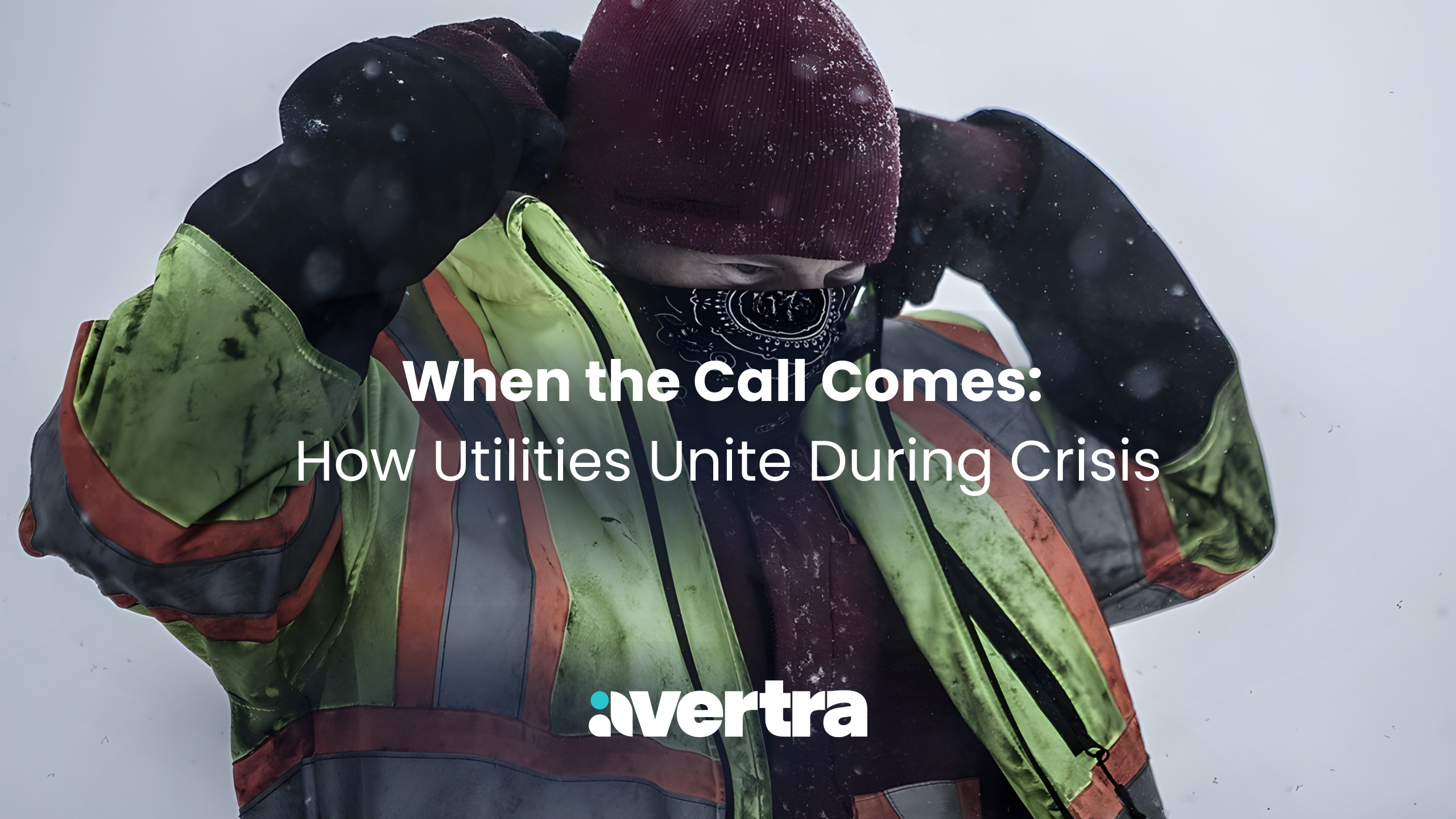
It’s 4:47 AM in Tampa. Marcus Rivera has yet to finish his coffee when his phone buzzes with a dispatch alert from Tampa Electric. Georgia needs help. Now.
He stares at the screen for a moment, sets his mug down, and starts packing.
His wife knows the drill. Months ago, when Hurricane Milton tore through Florida with howling winds, she watched crews from across the country pour into their neighborhood to help restore power. She remembers standing in their driveway with their kids, waving at bucket trucks from Michigan and Alabama rolling past.
Now it’s Marcus’s turn to be that truck for someone else.
The Storm That Froze the South
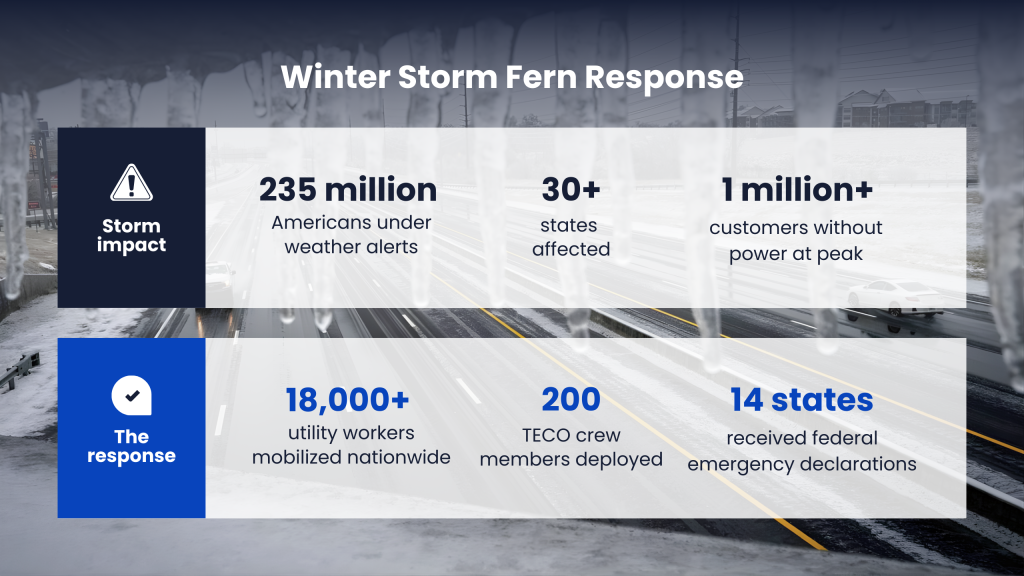
Winter Storm Fern arrived in late January 2025, stretching nearly 2,000 miles from the Southern Plains to the Northeast. This was the coldest stretch in five years, bringing ice accumulations that transformed power lines into icy sculptures and turned roads into hazards.
Governors across Georgia, Louisiana, Mississippi, Tennessee, the Carolinas, and at least 8 other states declared emergencies. Schools closed. Shelters opened. For families, the math was brutal: no power meant no heat, and no heat in these temperatures meant real danger.
But this is where the utility industry does something remarkable, Within hours, mutual aid networks were activated across the region. The Southeastern Electric Exchange coordinated resources. By the time Winter storm Fern’s outage restoration efforts were in full swing, more than 18,000 workers had mobilized from utilities across the United States. Among them, crews from Florida Public Utilities and Tampa Electric heading north to answer the call.
The Thread That Connects It All: Visibility
During any storm outage event, information becomes as essential as electricity itself.
Customers need to know if help is coming. CSRs need to answer questions accurately. Crews need context about what they’ll find. Every single stakeholder needs one thing: visibility.
When a customer calls asking about their storm outage, they’re really asking deeper questions. Does anyone know I’m in the dark? Is someone working on this? Am I alone?
The beacon that provides that visibility? The outage map.
A powerful outage map experience creates shared situational awareness, a single source of truth that customers, agents, crews, and leadership can all trust. It builds confidence through clear visibility into status and progress. It reduces inbound calls during critical events. It enables faster, smarter decision-making based on impact and data rather than guesswork. It identifies vulnerable populations so they receive appropriate attention.
When it works, trust holds. When trust holds, communities can focus on staying safe instead of staying angry.
Tampa Electric and Hurricane Milton: A crisis-ready outage map experience
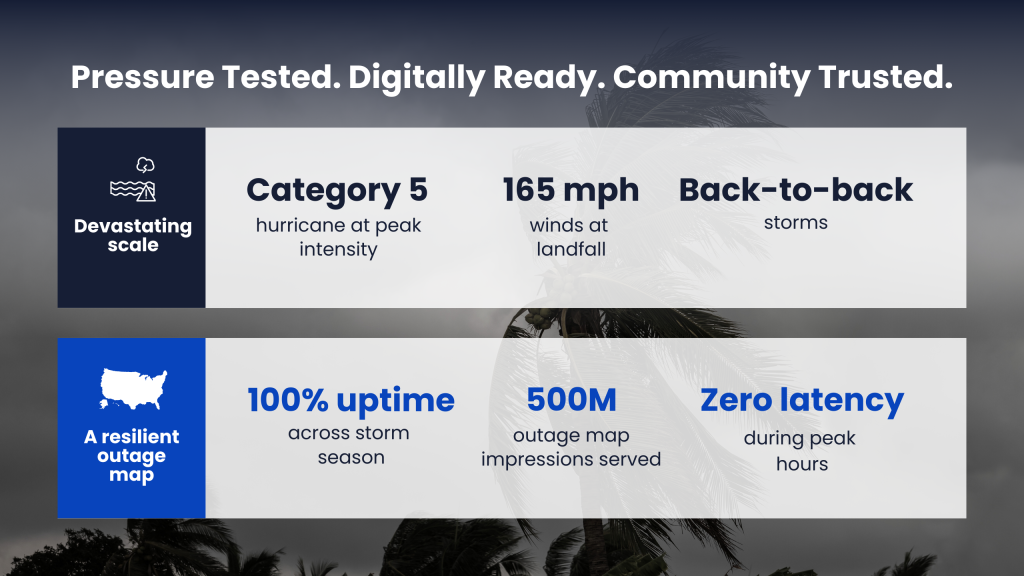
Hurricane Milton made landfall in Florida in October 2024 as one of the most intense storms to ever threaten Tampa Bay. A Category 5 monster bringing catastrophic winds and widespread devastation to a region still recovering from Hurricane Helene just weeks earlier.
When millions of eyes turned to the outage map, it held. MiCustomer DXP served as the experience fabric connecting every customer touchpoint. The outage map fed the portal, powered notifications, equipped CSRs with real-time data, and gave field operations visibility into customer impact.
What made this possible was preparation, and a partnership forged under pressure.
Years before Milton, when Tampa Electric’s previous outage map vendor failed mid-storm, they reached out to us with one question: how fast can you move? Within 19 hours, a working integration was live, pulling data, syncing systems, representing outages in real time. By 72 hours, they had a production-ready map with core functionality operational. What began as a safety net soon proved its worth as the foundation they could build on.
After the storm settled, Tampa Electric entrusted avertra in reimagining their outage map experience entirely through MiCustomer. Together, our teams simulated what would happen if 100% of customers lost power simultaneously. We intentionally stressed the platform to surface every weakness. We built Storm Mode, a feature that adjusts behavior during high-traffic events to ensure performance stays consistent when demand spikes most.
The Next Storm Is Forming
Somewhere right now, atmospheric conditions are shifting. The next major weather event is already taking shape. The question for every utility is when it will come, and whether you’ll be ready when it does.
Your outage map is a promise. A promise that when everything goes dark, your customers will know someone is aware. Someone cares. Help is actually coming. The right platform, and the right partner, gives you shared situational awareness across every stakeholder. It keeps every channel telling the same story. It turns a crisis into an opportunity to build trust rather than erode it.
Marcus made it to Georgia and back. He spent 2 weeks in the cold, restoring power to families he’d never meet again, fueled by the same sense of purpose that brought crews to his neighborhood when Milton hit.
That’s what this industry does. It shows up.
The question is: when your customers need you most, will your digital experience show up too?
Storm-built. Crisis-ready. Community-first.
Learn how MiCustomer helps utilities deliver resilient outage map experiences that perform when it matters most.
The lineworker depicted in this story is fictional but represents the 200 real Tampa Electric crew members who mobilized during Winter Storm Fern, and the tens of thousands of utility workers across America who answer mutual aid calls every year.