























A lineworker’s story, a historic ice storm, and the promise that keeps communities together when it matters most.
It’s 4:47 AM in Tampa. Marcus Rivera hasn’t finished his coffee when his phone buzzes with a dispatch alert from Tampa Electric. Georgia needs help. Now.
He stares at the screen for a moment, sets his mug down, and starts packing.
His wife knows the drill. Months ago, when Hurricane Milton tore through Florida with howling winds, she watched crews from across the country pour into their neighborhood to help restore power. She remembers standing in their driveway with their kids, waving at bucket trucks from Michigan and Alabama rolling past, grateful for strangers who’d driven hundreds of miles to help people they’d never meet.
Now it’s Marcus’s turn to be that truck for someone else.
The Storm That Froze the South
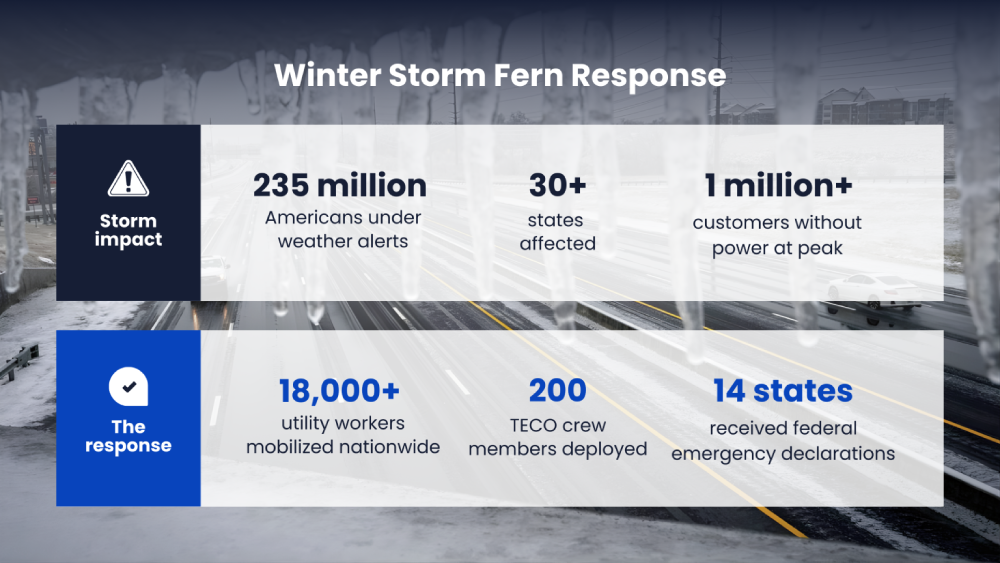
Winter Storm Fern arrived in late January 2025, stretching nearly 2,000 miles from the Southern Plains to the Northeast. This was the coldest stretch in five years, bringing ice accumulations that transformed power lines into fragile sculptures and turned roads into hazards.
Governors across Georgia, Louisiana, Mississippi, Tennessee, the Carolinas, and at least eight other states declared emergencies. Schools closed. Shelters opened. For families, the math was brutal: no power meant no heat, and no heat in these temperatures meant real danger.
In Augusta, Georgia, a mother named Sarah Chen sat with her two kids under a blanket, checking her phone every few minutes. The outage map showed her neighborhood shaded red, with no estimated restoration time yet.
“Just tell me someone knows” she thought. “Just tell me we’re not forgotten.”
She wasn’t.
When Your Neighbor’s House Is on Fire, You Grab a Hose
Within hours of Winter Storm Fern’s arrival, mutual aid networks across the Southeastern Electric Exchange began coordinating resources. By the time restoration efforts were in full swing, more than 18,000 workers had mobilized from utilities across the United States.
Among the first to answer that call: Tampa Electric and Florida Public Utilities.
For TECO leadership, the decision was immediate. Just months earlier, their own service territory had been devastated by Hurricane Milton. They knew exactly what darkness felt like—the uncertainty, the cold, the helplessness. They knew what it meant to watch neighbors wait, to answer calls from frightened customers, to work around the clock knowing every hour mattered.
When Georgia’s utilities sent out the call for help, TECO didn’t hesitate. More than 200 lineworkers packed their trucks and headed north into freezing conditions that many had never worked in before. These weren’t just crews fulfilling a contract—they were neighbors returning a favor to an industry that had shown up for them when they needed it most.
Florida Public Utilities mobilized alongside them. Their teams had restored thousands of customers during their own recent storms, and they brought that hard-earned experience to communities that desperately needed it. FPU crews worked around the clock in subfreezing temperatures, navigating ice-covered roads and damaged infrastructure to reach customers in the hardest-hit areas.
This is what drives the mutual aid commitment: an unspoken agreement that transcends state lines, corporate boundaries, and competitive markets. When your neighbor’s house is on fire, you don’t ask questions—you grab a hose. When another utility’s customers are suffering in the dark, you send your best people, your best equipment, and you trust that when your turn comes, they’ll do the same.
Marcus Rivera was one of those 200 TECO crew members. When he arrived in Augusta after a 10-hour drive, he saw the same thing he’d seen in Tampa after Milton: ice-laden trees across power lines, transformers damaged by falling limbs, entire neighborhoods sitting in darkness. But he also saw something else—the Georgia Power crews who’d been working for 48 hours straight, the local emergency responders coordinating shelters, the neighbors checking on elderly residents.
Everyone showing up. Everyone doing their part.
The Invisible Thread: Why Information Becomes Lifeline
Back in Augusta, Sarah Chen refreshed the outage map again. This time, it showed a crew assigned to her area. Estimated restoration: 6 PM. She exhaled for the first time in hours.
That simple update represented an extraordinary invisible effort happening behind the scenes. Behind that screen were dispatchers coordinating crews from five different states, systems tracking thousands of outages simultaneously, engineers prioritizing hospitals and critical infrastructure, and customer service agents fielding hundreds of panicked calls from families who just needed to know someone was listening.
During crisis, information becomes as essential as electricity itself.
Customers like Sarah need to know help is coming. Crews like Marcus need to know where the damage is worst, which areas to prioritize, how many customers are affected by each outage. Agents need accurate information to give frightened callers. Leaders need visibility into impact and progress to make critical resource decisions. Emergency responders need to know which neighborhoods to check for vulnerable residents.
Everyone needs the same truth, updated in real time, accessible from anywhere.
When that system works—when the information is reliable, when the map stays live, when every stakeholder can trust what they’re seeing—something powerful happens. Trust holds. And when trust holds, communities can focus their energy on staying safe instead of staying angry. Frustration gives way to patience. Anxiety gives way to hope.
The outage map becomes more than data. It becomes a promise: We see you. We’re coming. You’re not forgotten.
Built to Withstand the Worst
Tampa Electric learned the critical importance of that promise during Hurricane Milton.
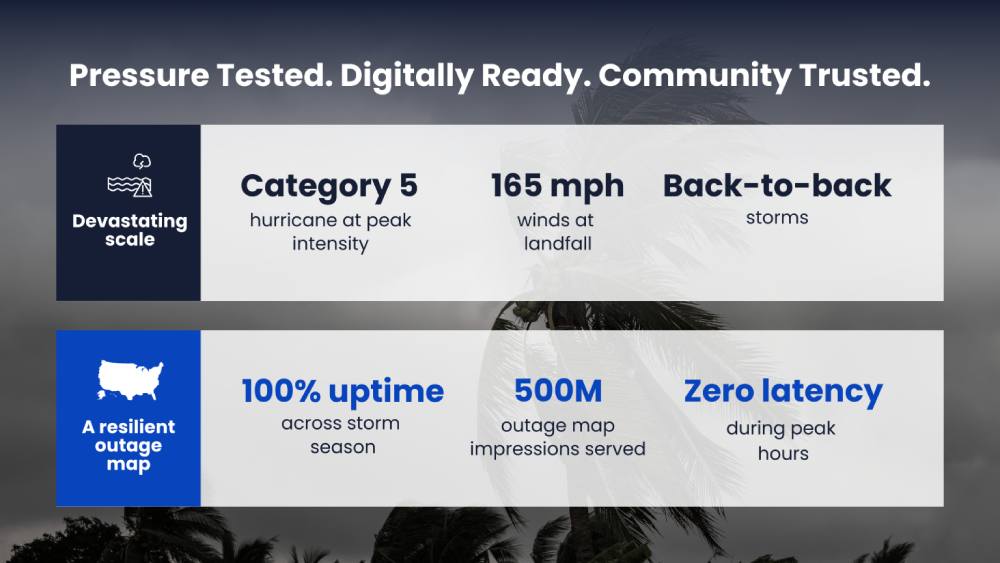
When the Category 5 storm slammed into Florida in October 2024, their outage systems faced unprecedented demand. Millions of customers turned to TECO’s MiCustomer outage map looking for answers. If customers lost faith in the information, they lost faith in the entire response.
The map held. Through 94,000 simultaneous users and hundreds of thousands of updates, it delivered what people needed most: visibility and reassurance that help was on the way.
That same infrastructure—tested under Florida’s worst conditions—gave TECO leadership the confidence to send 200 crew members to Georgia, knowing their own customers would stay informed while their workers helped restore power 500 miles away.
The Promise We Keep
This is what the utility industry does at its best. It shows up.
Tampa Electric showed up for Georgia families, sending crews into brutal conditions because it was the right thing to do. Florida Public Utilities showed up with expertise and determination. Thousands of lineworkers from across the Southeast showed up, bound by an unspoken promise that when the call comes, you answer.
And behind it all—the systems that kept everyone informed, connected, and working toward the same goal.
The outage map isn’t just technology. It’s a dispatcher coordinating crews across five states. It’s an agent telling a scared parent, “Yes, we see your outage, and here’s when we expect restoration.” It’s a utility executive confidently sending crews hundreds of miles away, knowing customers back home will stay informed.
It’s the infrastructure that turns compassion into action. The thread that connects strangers across state lines into a community that takes care of each other when it matters most.
It’s a promise that when everything goes dark, someone knows. Someone cares. And help is actually coming.
Learn how MiCustomer helps utilities deliver resilient outage map experiences that perform when it matters most.
The characters in this story are fictional but represent real events. The 200 Tampa Electric crew members who mobilized during Winter Storm Fern, the Florida Public Utilities teams who answered the call, and the tens of thousands of utility workers across America who participate in mutual aid every year are the true heroes of this story.